





By Mark Shelling
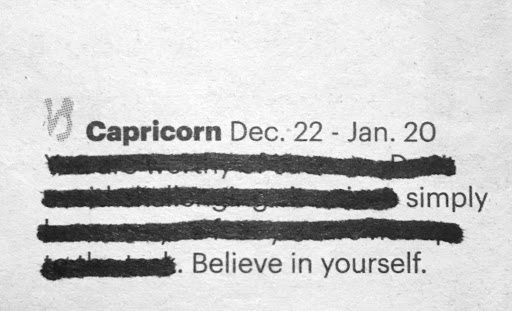
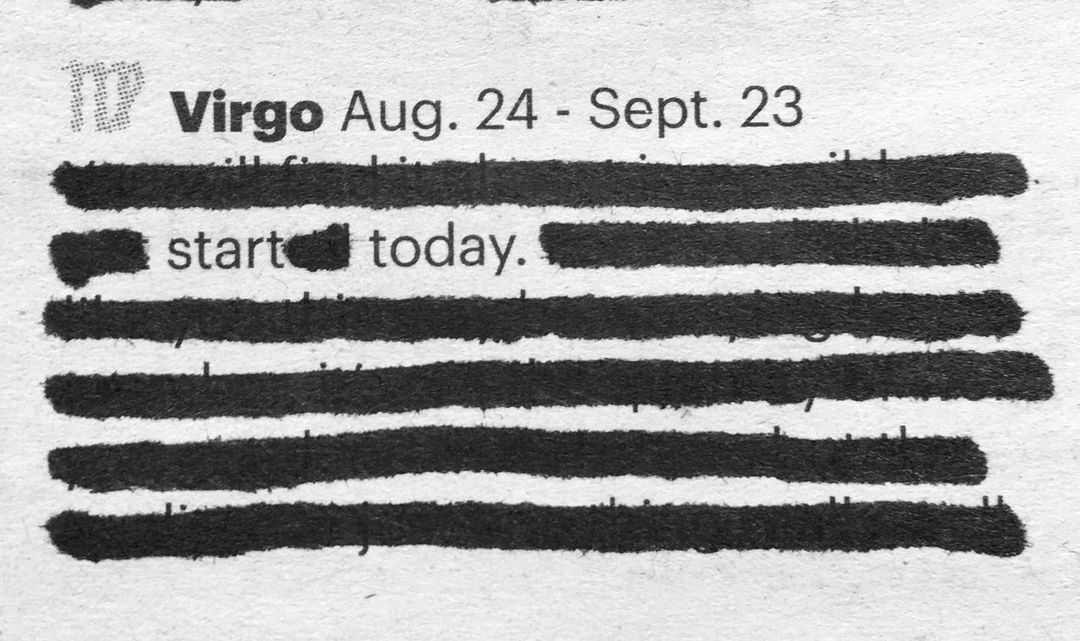
You wouldn’t be alone if you found yourself trying to salvage some personal stability through the last few turbulent years. Despite brands and influencers constantly blasting motivational messaging, it can all ring a bit like one size fits all self-help. Hidden Horoscopes however, offers messages that are so specific, that you can’t help but relate. The artist behind this negative space wisdom is Ryan Walter Wagner. He’s been carving words away from newspaper horoscopes for 10 years now, and in the process, has created something personal out of the interpretive.
“It all started while I was living with my friend Travis. I was relaxing on the couch one day, and saw one of those daily papers sitting on the coffee table, so I picked it up and instinctively started blacking out words in the horoscopes section.”
From first cracking up his roommate with the project, to then sharing on Tumblr, and now to full-fledged exhibitions, the Hidden Horoscopes (originally titled 2nd hand news) has continued to catch on.
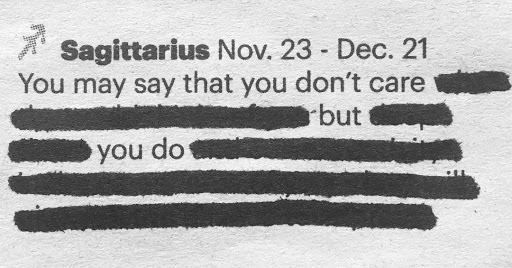
Looking through the countless horoscopes Wagner has redone, it’s interesting how seeing the blacked out words gives more meaning than if the untouched words were simply presented on their own. It’s a rare art that the medium becomes part of the message. Where anyone can come up with a slogan or fortune, this takes the skill of seeing through the clutter. It’s a process that Wagner says is harder than you’d think.
“Sometimes they jump right off the page and other times they can take forever to make something that works. I can only do a few at a time, because my brain starts to scramble if I spend too much time looking at them. The real tactic is trying to not look at words, and instead, reading the whole thing and deciding what the message is.”
Being dependent on newspapers for horoscopes also poses challenges. Wagner has taken to soliciting periodical companies for old issues that could supply his next canvas. It’s a search that has had diminishing returns with physical print not being what it was. But, surely that’s no challenge, when you’re harnessing the power of the stars.
“I don’t actually know much about astrology. I just like creating fun, positive messages for people.” Ok, scratch that about star power, it’s about the power of positivity, I’ll black that first part out later.
It’s an encouraging voice in a time when people are flooded with noise. One that will hopefully carry on into the future (pending finding more old newspapers). Scanning through Wagner’s Instagram page, always presents a good chance to stock up on a brighter outlook before any more of the foreseeable future gets blotted out. Just a matter of highlighting the positive messages through the darkness.
“Sometimes if you have that frame of mind, you can start to create something that brings you a bit of joy.”
To learn more about Hidden Horoscopes, visit society6.com/hiddenhoroscopes
Or follow Ryan on Instagram here: @hiddenhoroscopes