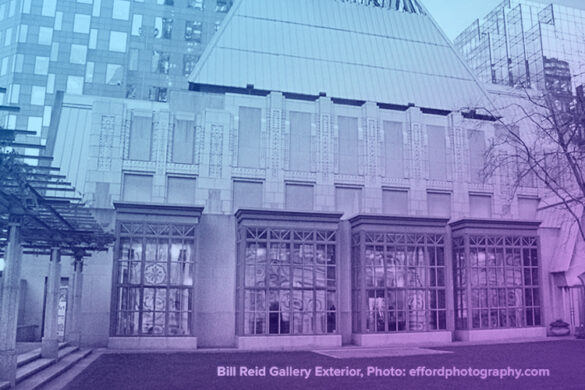

Guest curated by Salish artist Eliot White-Hill, Kwulasultun, this exhibition brings together the work of 11 Coast and Interior Salish artists working across sculpture, printmaking, textiles, painting, and mixed media.
Guest curated by Salish artist Eliot White-Hill, Kwulasultun, this exhibition brings together the work of 11 Coast and Interior Salish artists working across sculpture, printmaking, textiles, painting, and mixed media. Together, their practices reveal the deep cultural, linguistic, and artistic relationships that flow across the Salish world.
While institutional narratives have often centered on Coastal Salish art, this exhibition broadens the lens, foregrounding the vital interconnectivity between Interior and Coast Salish communities. In doing so, it challenges the historic marginalization of Salish art within broader Northwest Coast art histories.
At the heart of the curatorial vision is the river, both a living presence and a powerful metaphor, linking land, water, identity, and evolving cultural practices.
The exhibition celebrates Salish art as dynamic, sophisticated, and forward-looking, affirming its place as both culturally essential and artistically visionary.
Featuring influential artists who have paved the way, including Susan Point and Angela Paul, alongside emerging voices shaping the future, this exhibition offers a resonant and timely exploration of continuity, connection, and creative resurgence.
Bill Reid Gallery
639 Hornby Street
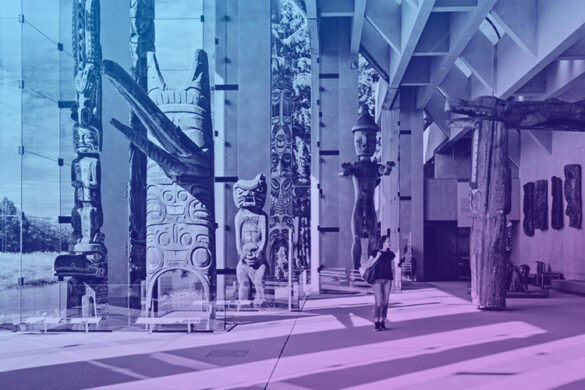
Tupananchiskama: Ancient Andean Cosmovision explores the enduring worldviews of ancient Andean civilizations through nearly 100 exquisite pre-Columbian ceramic, textile, bone and wood works, some dating back more than 2,500 years. These works were collected by former UBC Professor
Tupananchiskama: Ancient Andean Cosmovision explores the enduring worldviews of ancient Andean civilizations through nearly 100 exquisite pre-Columbian ceramic, textile, bone and wood works, some dating back more than 2,500 years. These works were collected by former UBC Professor Alan R. Sawyer and donated to MOA. The Andes are home to some of the world’s most complex cultural traditions, and its knowledge lives on in landscapes, practices, languages, and material culture.
This exhibition highlights Andean cosmovision—a holistic and spiritual understanding of the universe grounded in reciprocity, balance, and the recognition of nature as a living being. Far more than artistic objects, the belongings on display embody relationships between humans, ancestors, and sacred forces.
Tupananchiskama, is a word in Quechua, an Indigenous language of the Andes. It means “until life brings us together again” and reflects an ancestral view of life and death as part of a continuous cycle. In Andean philosophy, death is not an end but a transformation. Through the belongings in this exhibition, visitors are invited to reflect on continuity, resilience, renewal, and the promise of reunion.
Museum of Anthropology
6393 N.W. Marine Drive
More than 200 works. Over 100 artists. One exhibition. Permanent collection exhibitions are vital to a collecting institution, offering insight into both a visual history of place and the values that
Permanent collection exhibitions are vital to a collecting institution, offering insight into both a visual history of place and the values that define the museum today.
Highlights from the Collection is drawn entirely from the Vancouver Art Gallery’s permanent collection and will be presented over a three-year period, with scheduled rotations of works on paper and photography.
This exhibition traces the evolving history of the Gallery’s collection through the environments in which art has lived, circulated and gathered meaning. From historical paintings to contemporary installations, artworks are presented in groupings that reflect the cultural and aesthetic contexts in which they were originally shown, including the formal arrangements of a salon-style installation, the domestic space of a modernist home, the experimental spaces of artist-run centres and the white cube galleries of the twenty-first-century museum.
Featuring art from this region while situating it within a wider global context, Highlights from the Collection considers how local developments connect to international movements. Ultimately, it tells a story—through the shifting of values, voices and aesthetic visions—of how art is shaped by place, and how place, in turn, is shaped by art.
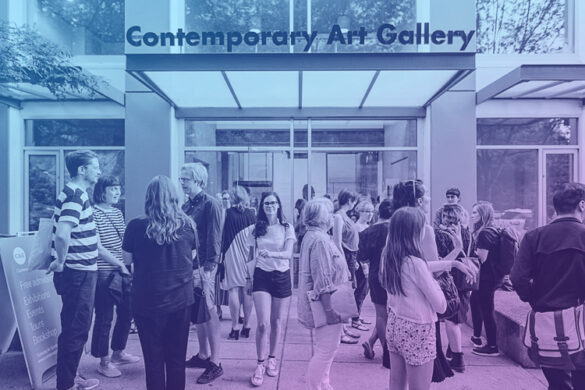
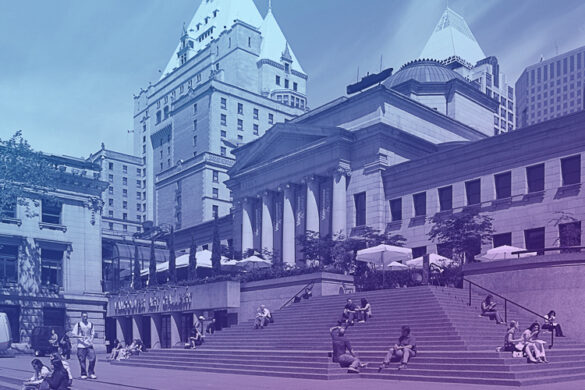
Vancouver Art Gallery
750 Hornby Street
As the environmental crisis accelerates, artists around the world are responding with urgency, insight and vision. Future Geographies: Art in the Century of Climate Change is the first major exhibition
As the environmental crisis accelerates, artists around the world are responding with urgency, insight and vision. Future Geographies: Art in the Century of Climate Change is the first major exhibition in Canada to examine the intersection of the climate crisis and contemporary art on a global scale.
Featuring works from the past 25 years, this exhibition underscores the urgency and relevance of sustainability and the environment as defining issues of our time. More than 35 works across a range of media—from large-scale video installations to living sculptures—invite viewers to confront pressing questions about our shared future on this planet.
Presented across multiple floors, Future Geographies includes a newly commissioned work by Jeffrey Gibson and marks the first time several artists are exhibiting in Vancouver, including Teresita Fernández, Josh Kline, Cannupa Hanska Luger, Jean Shin and Clarissa Tossin. The exhibition also features major works by BC–based artists such as Brian Jungen, Gabrielle L’Hirondelle Hill and Lawrence Paul Yuxweluptun Lets’lo:tseltun, connecting global issues with local specificity. Together, the works in this exhibition invite dialogue and create space for imagining.
In conjunction with the exhibition, the Vancouver Art Gallery is partnering with the University of British Columbia Climate Action Lab to create unique platforms for cross disciplinary dialogue. After its presentation at the Vancouver Art Gallery, Future Geographies will travel to the Art Gallery of Ontario.
Future Geographies will continue on the Gallery’s 4th Floor with the immersive installation SANCTUARY: The Ancient Forest Experience, by Dr. T’uy’t’tanat Cease Wyss, Damien Gillis and Olivier Leroux, and a presentation of cedar works by local artists, curated by Dr. Wyss.
A public artwork by Cannupa Hanska Luger will be featured on a billboard on 1611 E Hastings Street (near Commercial Drive) and is a collaboration with Capture Photography Festival.
Vancouver Art Gallery
750 Hornby Street