



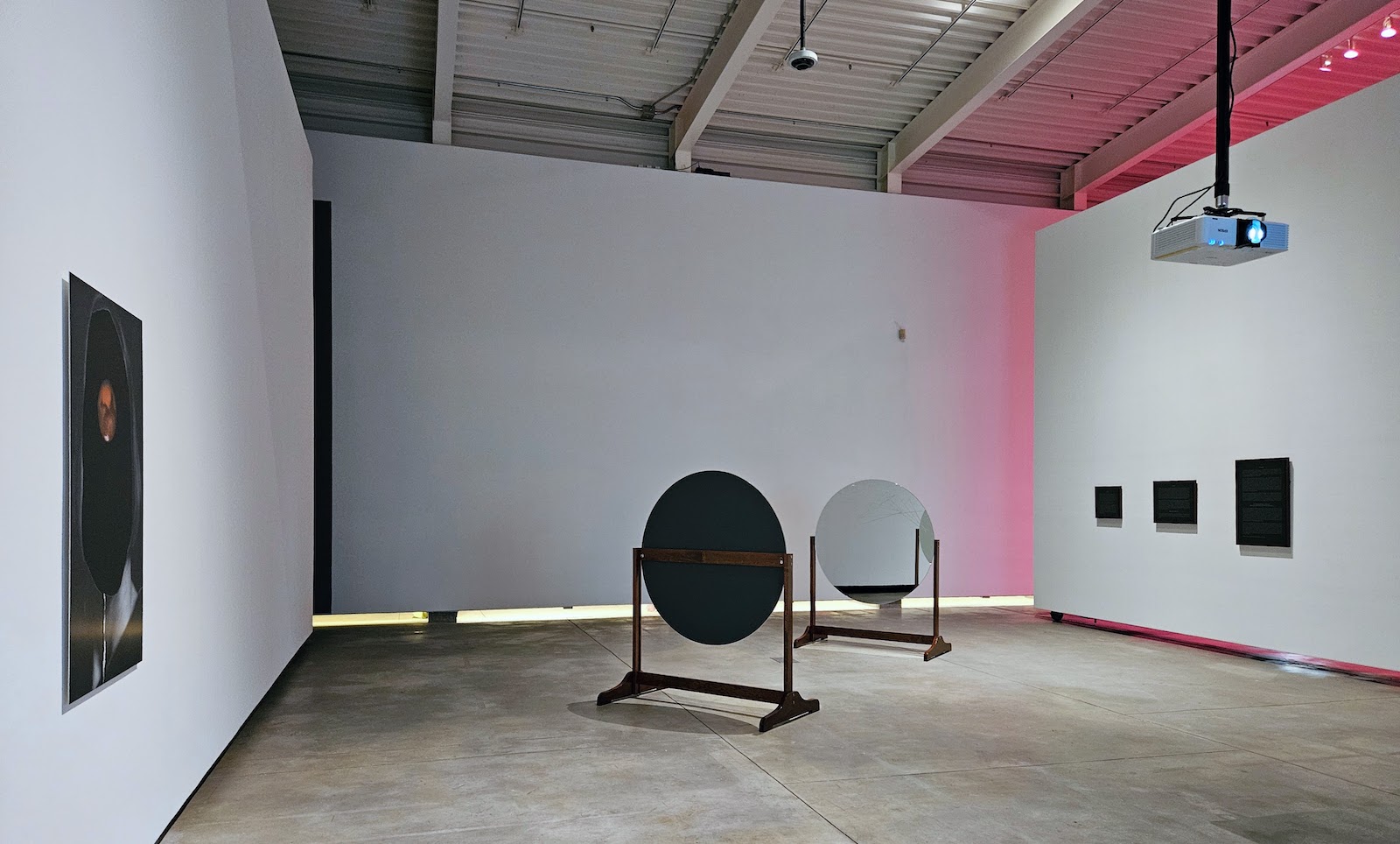
Through large-scale experiential works, installations, film, sculpture, textile works, and painting, Aporia (Notes to a Medium) at the Morris and Helen Belkin Art Gallery explores multiple themes that teeter between contrasting ideas: real and pretend uncertainty, delusion and reality, the past and the future, and doubt as a space for critical reflection and as a tactic.
Curated by the Belkin’s Melanie O’Brian, the exhibition brings together work spanning the past two decades by nine artists: Colleen Brown, Azza El Siddique, Dani Gal, Katie Kozak and Lucien Durey, Mark Lewis, Jenine Marsh, Jalal Toufic, and Elizabeth Zvonar.
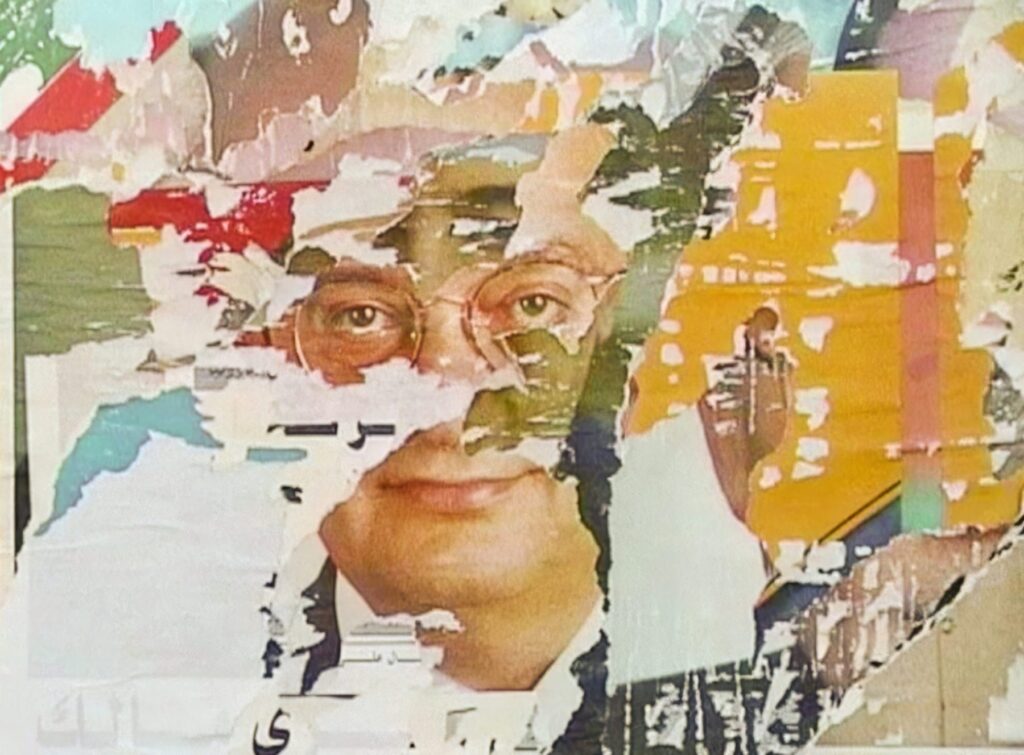
In the exhibition text, O’Brian describes: “Aporia (Notes to a Medium) considers how history, mythology and wishful thinking entwine across media and through mediums. In this moment where faith in media, government and institutions is further collapsing, where binarization is on the rise, where expressions of doubt are tactical, this exhibition includes artists’ works that contend with systems of belief and perception to trouble truth’s material (and immaterial) forms.”
The exhibition begins before even entering the gallery. A black-and-white ocean scene is projected onto the building’s outdoor screen, with freighters on the horizon conveying a dreamy yet eerie feel. The work is Mark Lewis’s From Third Beach 1 (2010), shot mid-day on Third Beach in Vancouver. The artist quotes a classic Hollywood technique, “day for night,” where the sun stands in for the moon to create a night-time scene, albeit unconvincingly. In doing so, Lewis “reveals the perceptual slippage—and doubt—in image-making.”
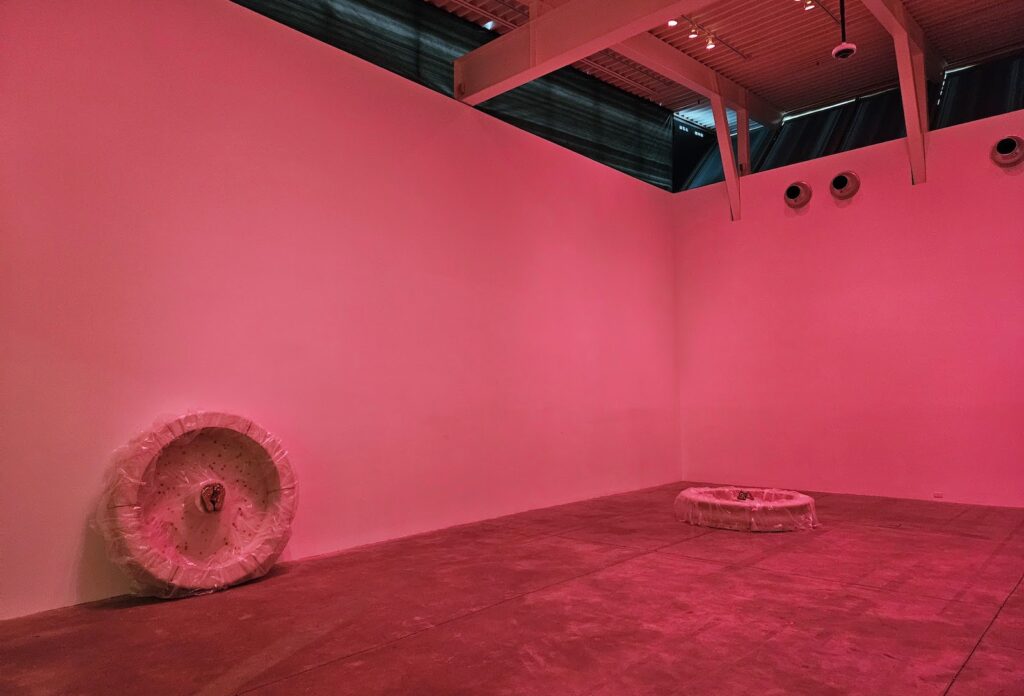
Once inside the main gallery, Jenine Marsh’s installation of three sculptures, How to Fulfill a Wish (Bronze, Silver, Gold) (2023), considers social practices around the public fountain or wishing well. The works include scaled-down wishing wells, wrapped in plastic, with cast bronze feet at the centre, and coins and dried flowers scattered around. One hangs on a wall, another is propped up against a wall, and a third sits on the floor. Surprisingly, they are made of foam and actually lightweight. The entire space is filled with pink, thanks to lighting gels on the ceiling, part of another work titled Optimism (2023).
Next, as you stand between Elizabeth Zvonar’s installation Timing is Everything (2006) where two round mirrors are positioned facing one another, you see yourself reflected multiple times. (A trick that never ceases to entertain.) The mirrors are etched with astrological birth charts related to NASA’s Voyager program. Accompanying texts, positioned on the wall, explore time and notions of the future.
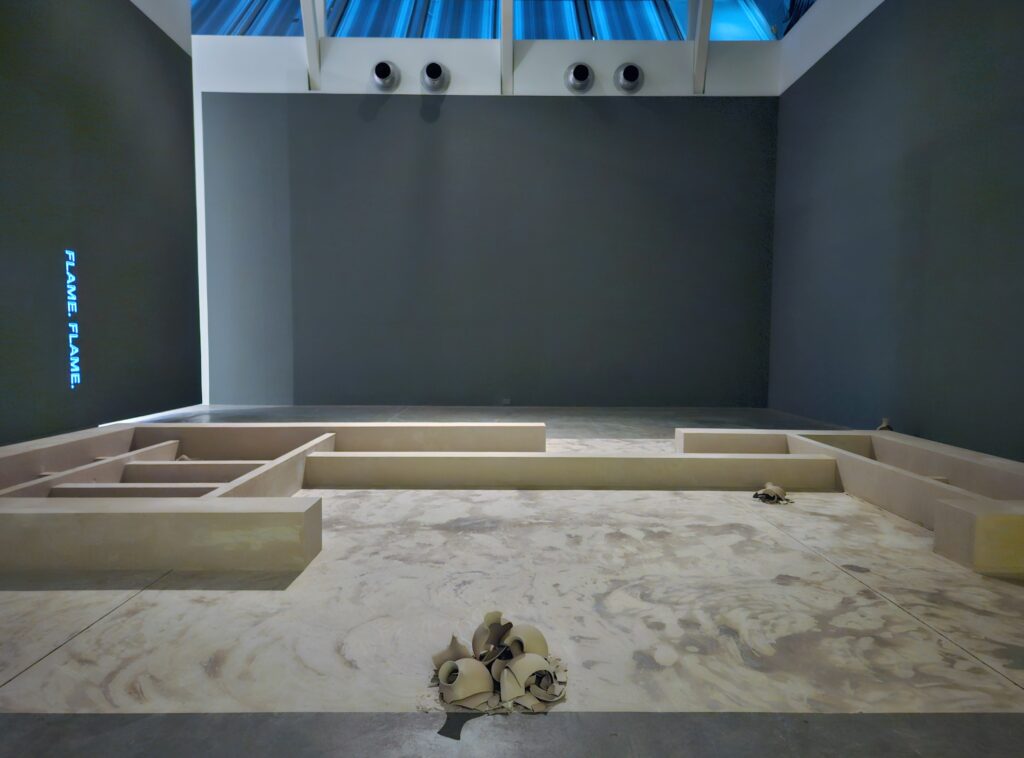
In another room, Azza El Siddique’s Solar Evocation (2022) explores ancient Egyptian and Nubian culture and ideas around death, the afterlife, and re-birth. Based on the Coffin Text The Book of Two Ways, the large-scale, sculptural environment consists of long plinths laid out on the floor like a map or maze. Broken ceramic vessels are scattered in three piles. Text scrolls down opposite walls, actual spells from The Book of Two Ways.
A large textile installation titled Covers (2023) by long-time collaborators Katie Kozak and Lucien Durey explores memory. Visitors are invited to touch and walk through a series of coloured curtains made of dyed bed sheets. A delightful and fun experience!
There’s much to explore, experience, and consider through the works in the show. The exhibition extends elsewhere on campus: at Koerner Library, visitors can find Zvonar’s digital collage Gattamelata (2020) on view. Numerous related events delve deeper into the exhibition including artists talks, a concert at the gallery presented by UBC Contemporary Players, an outdoor film screening of Jalal Toufic’s Variations on Guilt and Innocence in 39 Steps, and more. Visit the gallery’s website for dates and details.
Aporia (Notes to a Medium) is on view until April 14, 2024 at the Morris and Helen Belkin Art Gallery at UBC.
Gallery hours are Tuesday to Friday, 10AM-5PM; Saturday and Sunday, 12-5PM.
Admission is free.

1825 Main Mall, VancouverGet there on transit: Take bus 44, 84, R4, or 99 to the UBC Bus Loop. From there, it’s about 1.1km or 15-minute walk to the gallery. To plan your trip, please see TransLink’s Trip Planner.