Jim Lambie transforms everyday architectural spaces into immersive, energetic experiences through his vibrant vinyl tape installations. These site-specific works are an extension of his acclaimed Zobop series, which uses brightly coloured strips
Jim Lambie transforms everyday architectural spaces into immersive, energetic experiences through his vibrant vinyl tape installations. These site-specific works are an extension of his acclaimed Zobop series, which uses brightly coloured strips of industrial vinyl tape to contour the architectural space, wrapping its form in optical rhythm and vivid saturation.
Lambie is a Glasgow–based artist, DJ and musician. His practice draws from pop culture, music and Minimalism, and he often uses inexpensive, ready-made materials. In the Zobop works, which date back to the late 1990s, he meticulously applies tape in concentric patterns that respond to and amplify the geometry of the space. The effect is both playful and disorienting—simultaneously flattening and deepening the visual field.
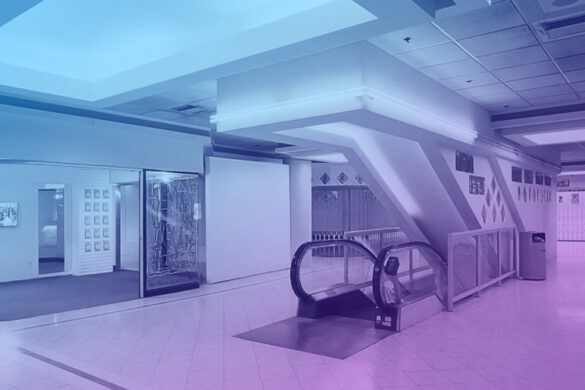
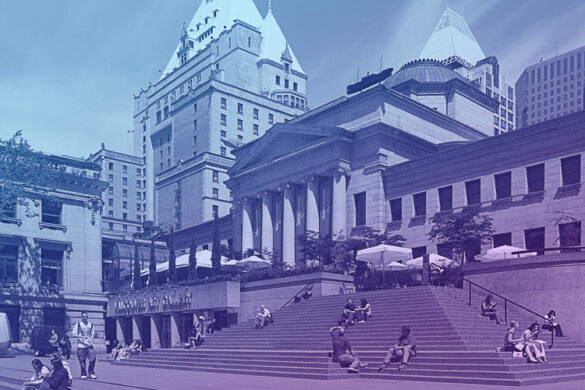
Installed directly onto the stairs and floor of the Gallery’s Rotunda, Zobop (Colour-Chrome) (2019) blurs the boundaries between sculpture, installation and drawing. The works activate the act of moving through space, turning the mundane journey up or down a stairwell into a psychedelic, performative experience and radically shifting how we understand place—in this iteration, the Gallery’s architecture.
Vancouver Art Gallery
750 Hornby Street
That Green Ideal: Emily Carr and the Idea of Nature is the largest solo exhibition of iconic British Columbia artist Emily Carr (1871–1945) at the Vancouver Art Gallery in over
That Green Ideal: Emily Carr and the Idea of Nature is the largest solo exhibition of iconic British Columbia artist Emily Carr (1871–1945) at the Vancouver Art Gallery in over twenty years.
Featuring more than 100 works, it explores in-depth the artist’s obsession with the landscape of the Pacific Northwest, using close analysis of her paintings and writings to investigate how she understood nature and her relationship to it. The exhibition argues that Carr’s landscapes exist at the intersection between an experience of nature and an idea about how to transmit that experience through a painting, with the goal of expressing a divine essence in nature. It teases out the tension between individual and local references and the larger ideas and philosophies about nature in Western cultural traditions.
Vancouver Art Gallery
750 Hornby Street
Guest curated by Salish artist Eliot White-Hill, Kwulasultun, this exhibition brings together the work of 11 Coast and Interior Salish artists working across sculpture, printmaking, textiles, painting, and mixed media.
Guest curated by Salish artist Eliot White-Hill, Kwulasultun, this exhibition brings together the work of 11 Coast and Interior Salish artists working across sculpture, printmaking, textiles, painting, and mixed media. Together, their practices reveal the deep cultural, linguistic, and artistic relationships that flow across the Salish world.
While institutional narratives have often centered on Coastal Salish art, this exhibition broadens the lens, foregrounding the vital interconnectivity between Interior and Coast Salish communities. In doing so, it challenges the historic marginalization of Salish art within broader Northwest Coast art histories.
At the heart of the curatorial vision is the river, both a living presence and a powerful metaphor, linking land, water, identity, and evolving cultural practices.
The exhibition celebrates Salish art as dynamic, sophisticated, and forward-looking, affirming its place as both culturally essential and artistically visionary.
Featuring influential artists who have paved the way, including Susan Point and Angela Paul, alongside emerging voices shaping the future, this exhibition offers a resonant and timely exploration of continuity, connection, and creative resurgence.
Bill Reid Gallery
639 Hornby Street
Tupananchiskama: Ancient Andean Cosmovision explores the enduring worldviews of ancient Andean civilizations through nearly 100 exquisite pre-Columbian ceramic, textile, bone and wood works, some dating back more than 2,500 years. These works were collected by former UBC Professor
Tupananchiskama: Ancient Andean Cosmovision explores the enduring worldviews of ancient Andean civilizations through nearly 100 exquisite pre-Columbian ceramic, textile, bone and wood works, some dating back more than 2,500 years. These works were collected by former UBC Professor Alan R. Sawyer and donated to MOA. The Andes are home to some of the world’s most complex cultural traditions, and its knowledge lives on in landscapes, practices, languages, and material culture.
This exhibition highlights Andean cosmovision—a holistic and spiritual understanding of the universe grounded in reciprocity, balance, and the recognition of nature as a living being. Far more than artistic objects, the belongings on display embody relationships between humans, ancestors, and sacred forces.
Tupananchiskama, is a word in Quechua, an Indigenous language of the Andes. It means “until life brings us together again” and reflects an ancestral view of life and death as part of a continuous cycle. In Andean philosophy, death is not an end but a transformation. Through the belongings in this exhibition, visitors are invited to reflect on continuity, resilience, renewal, and the promise of reunion.
Museum of Anthropology
6393 N.W. Marine Drive