


The artists in this exhibition all have direct connections to Surrey. The selected artworks from the Gallery’s permanent collection explore place from different perspectives. Some offer notions of place that
The artists in this exhibition all have direct connections to Surrey. The selected artworks from the Gallery’s permanent collection explore place from different perspectives. Some offer notions of place that are fantastical, such as the miniature home in Al McWilliams’ mixed media sculpture Eggscape II. Others represent local ecology, as in Arnold Mickelson’s elegant wooden carving Sandpiper with Egg. Still others document changing moments in the city’s landscape, as painted in Jeremy Herndl’s View from Whalley BC, April 18, 2011. The artworks encourage visitors to consider where we are, how we engage with communities, and how we act as stewards of the natural world.
Surrey Art Gallery
13750 88 Ave
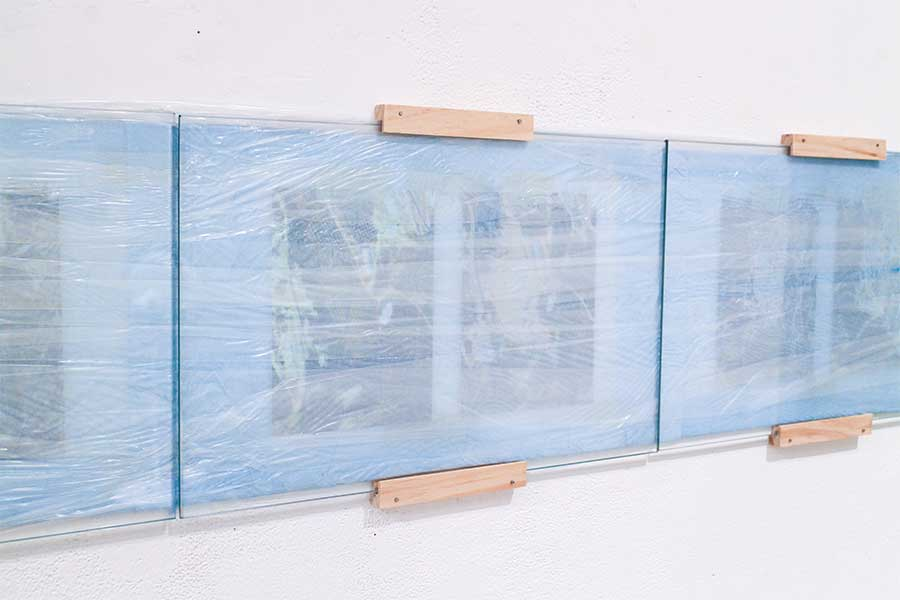
Bringing together textile, sculptural, and text-based works, this exhibition considers weaving as an embodied practice through which acts of making become gestures of memory, inherited knowledge, and self-exploration. Both artists engage
Bringing together textile, sculptural, and text-based works, this exhibition considers weaving as an embodied practice through which acts of making become gestures of memory, inherited knowledge, and self-exploration.
Both artists engage with family histories and inherited cultural narratives. Cleave incorporates pine needles and rice grains into their woven sculptures—everyday materials with cultural significance across East Asia. Vega as Floodwater and Sieve reimagine the folktale of the Cowherd and the Weaver Girl, known in Japan as Hikoboshi, a mortal man, and Orihime, a celestial deity. The two fell in love but were separated by the Milky Way. Using organic materials that warp and break, Cleave assembles delicate sculptures held together through a meticulous and laborious process.
Through his own interest in weaving, Jonathan Alfaro stumbled upon his grandfather’s weaving practice under Spanish colonialism. In Y Mis Huesos se Sienten Viejos,he examines the complex relationship between family lineage and self-identity. In addition to working with traditional weaving techniques, Alfaro developed techniques to deconstruct linen fabrics, creating intricate patterns that accentuate the texture of the material, reconstructing them into something new and beautiful.
Through their respective experimentation with the technique and materiality of weaving, Alfaro’s and Cleave’s works reimagine the medium’s form and dimensionality.
Surrey Art Gallery
13750 88 Ave
Informed by their family background in Traditional Chinese Medicine (TCM), SF Ho draws parallels between principles of TCM and human-ecology relationships, imagining how care for the land can be interpretated
Informed by their family background in Traditional Chinese Medicine (TCM), SF Ho draws parallels between principles of TCM and human-ecology relationships, imagining how care for the land can be interpretated as a form of relationality.
Central to the exhibit is the floor sculpture Triple Burner Flower Field made from clay referencing the oracle bone character for 回, the Chinese character for “return to”. The sculpture, surrounded by silk banners hand-dyed with tea and yarrow and printed with oracle bone characters, evokes the plant origins of some of the earliest written characters that would later evolve into Chinese script. Together, these works trace connections between principles of healing and language back to the land that shaped them.
Surrey Art Gallery
13750 88 Ave
Farheen Haq and Russna Kaur reflect on transformation in their distinct yet interconnected practices. Their works engage with memory and language as something carried, inherited, and continually remade. Haq’s time-based works in video, installation,
Farheen Haq and Russna Kaur reflect on transformation in their distinct yet interconnected practices. Their works engage with memory and language as something carried, inherited, and continually remade.
Haq’s time-based works in video, installation, performance, and photography remember and reimagine her South Asian Muslim Canadian female identity through the body and lived experience. Her new works focus on the teachings of the Ganga-Jamuni tehzeeb (a confluence of communal harmony and cultural respect in the areas around the Ganga and Jamuni rivers in northern India). Haq says these teachings can be applied to settler-Indigenous relationships on Turtle Island through culture making and ceremony.
Kaur’s expansive, multi-surface paintings unfold as living landscapes of recollection where colour, texture, and form trace personal, emotional, and intergenerational South Asian histories. Layer by layer, each work holds moments of recalling and losing, revealing memory not as something fixed but as continually carried, reshaped, and transformed.
This exhibit grows from two works in the permanent collection: Haq’s brick and video installation Revelation #2 and Kaur’s abstract painting Nice Ending. Added to these are new and loaned works where memory is embedded within materials and passed through gestures of mark-making. Threading the visual languages of embroidery, fabric, and painting, the artists reveal that textiles and texts are not simply objects but vessels of knowledge, care, and resilience.
Surrey Art Gallery
13750 88 Ave


